Female condoms as an alternative to standard contraceptive methods
When it comes to barrier contraception, most people automatically imagine the classic male condom. However, in the world of intimate health, there is another extremely reliable, but somehow completely underestimated means of protection — the female condom, also known as an internal condom or femidom.
This invention gives a woman full autonomy and control over her own safety, protecting against both unwanted pregnancy and sexually transmitted infections (STIs). We offer a detailed overview of the female condom: we will break down its structure, main advantages, and rules of use so that you can expand your arsenal of safe sex.
What is a female condom: structure and materials
Visually, a female condom is significantly different from a male one. It is a thin, soft, and transparent tube that has two flexible rings at both ends.
1. The inner ring (closed) is located at the blind end of the tube. It is designed to be inserted deep into the vagina and securely fix the product on the cervix.
2. The outer ring (open) remains outside, slightly covering the labia.

While classic contraceptives are most often made of latex, the main material for female condoms — is polyurethane or nitrile. This is a huge plus for couples who are allergic to latex. In addition, polyurethane conducts body heat much better, thanks to which sensations during intimacy remain as natural as possible. Another chemical bonus of polyurethane: unlike latex, it is not destroyed by fats, so you can safely use any lubricants with a female condom, including oil-based ones.
Main advantages compared to male condoms
Female condoms have a number of unique features that make them indispensable in many situations. Here are the key advantages compared to male counterparts:
- Female autonomy: A woman controls her protection herself. You no longer need to rely on your partner's responsibility or persuade him to put on a contraceptive.
- Protection of a larger area: The outer ring of the female condom partially covers the external female genitals (vulva) and the base of the man's penis. This significantly reduces the risk of transmitting infections spread through "skin-to-skin" contact (for example, human papillomavirus (HPV) or genital herpes).
- Independence from erection: The female condom does not squeeze the penis and does not require a full erection to put on. It also will not slip off if the erection quickly disappears after ejaculation.
- Possibility of advance insertion: You can insert a female condom a few hours before the intended intercourse. This allows you not to interrupt romantic foreplay to search for and unpack a contraceptive in the hottest moment.
Step-by-step usage guide
At first glance, the design may seem unusual, but the insertion process is very similar to using a tampon or menstrual cup. Here is a step-by-step guide to using a female condom:
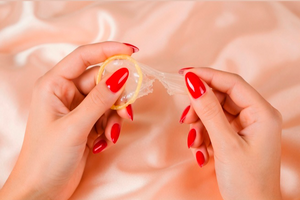
- Preparation: Wash your hands thoroughly. Carefully open the package without using teeth or scissors
- Comfortable position: Squat down, put one foot on a chair, or lie on your back with your knees spread — choose the position in which you are most comfortable.
- Squeezing: With your thumb and index finger, squeeze the inner (closed) ring so that it looks like the number "8".
- Insertion: Insert the squeezed ring into the vagina. Push it with your finger as deep as possible, right up to the cervix.
- Fixation: Make sure the condom has not twisted inside. The outer (open) ring should remain outside, protruding by about 1-2 centimeters.
- During the act: At the beginning of penetration, carefully guide your partner's penis inside the open ring so that it does not slip between the vaginal wall and the condom.
- Removal: After the act is completed (it is not necessary to do this instantly), twist the outer ring to "close" the contents, and carefully pull out the female condom. Throw it in the trash (never flush it down the toilet).
Why are female condoms underestimated?
Despite all the advantages, female condoms can rarely be found in the medicine cabinet of an average couple. Why does this happen?
Firstly, the lack of information and sexual education takes its toll. Most people simply don't know how to use them and are frightened by their unusual appearance. Secondly, the aesthetic factor: the outer ring that remains outside may seem not very attractive to some couples. Thirdly, the price. The production of polyurethane female condoms is more complicated, so they cost more than classic latex male counterparts and are harder to find in regular supermarkets.
Conclusion
Female condoms — are an excellent, modern, and reliable tool that gives women freedom, confidence, and an unprecedented level of health protection. You shouldn't be afraid of new formats. Try to integrate a female condom into your intimate life, and quite possibly, it will become your favorite method of contraception.
We invite you to our catalog, where you can choose high-quality barrier contraceptives for any needs. Take care of your comfort and safety today!