How to understand that your partner is pretending in bed — and what to do about it without scandals
Sex is not only about technique and physiology. Its foundation is trust, safety, and connection. That is why pretending in bed hurts more than it may seem. It touches not the ego, but the sense of closeness: “is he really with me right now?”, “does he trust me?”, “are our sensations real?”.
According to statistics, most couples have encountered imitation of orgasm. And in reality, this is almost never about a “bad partner.” Much more often, it is about fear of hurting, awkwardness, inability to talk about desires, pressure of expectations, or simple fatigue. But when it becomes a pattern, both sexual life and relationships suffer.
Understanding this means not looking for someone to blame, but returning honesty to your intimate space.
The body cannot lie well
Real pleasure is almost impossible to fully fake. Orgasm is a complex reaction of the nervous system, muscles, and breathing. When a person truly reaches peak arousal, the body reacts on its own: breathing rhythm changes, involuntary muscle tension appears, heartbeat increases, the skin becomes warmer, and after intimacy there is often a need for pause, touch, rest.
During simulation, attention is more often focused not on sensations, but on the “role”: how to sound, how to look, when it is “time.” In such moments, overly sharp or monotonous moans may appear that do not match body movements, lack of response to touch, mechanical reactions without gradual build-up of arousal.
Intuitively, this feels like the absence of real contact.
Important: absence of orgasm is not equal to simulation. But regular “acting,” when the body is not involved and reactions look learned, almost always indicates internal tension.
Behavioral signs worth paying attention to
If a partner often avoids eye contact, rushes to “finish” sex, rarely shows initiative, does not guide, does not hint, does not respond to changes in rhythm or caresses — this may not be indifference, but on the contrary, an attempt to end the process faster without confrontation.
Simulation is also accompanied by loss of interest in experiments, conversations about desires, novelty. When a person feels good, they seek to prolong contact, not formally end it.
Why people pretend
The reasons are almost always psychological:
- fear of hurting a partner
- feeling that one “must” orgasm
- shame about one’s body or reactions
- fatigue, hormonal disruptions, stress
- lack of skills to talk about sex
- past negative experience
- pressure of expectations from porn and social media
Simulation is not lying for benefit. It is a way to protect oneself, avoid conversation, or maintain relationships in a habitual way.
How to talk to your partner about it correctly
The most common mistake is exposing. Pressing with facts. Checking. Demanding “truth.”
This almost always only increases closedness.
It is much more effective to start not with suspicions, but with I-statements:
Not “you are pretending,” but “it is important for me that what is between us is real.”
Not “you feel nothing,” but “I want to understand your body better.”
It is better to talk outside the bedroom, in a calm state. Focus on connection, not on result. Questions work better than statements:
- “What do you like most right now?”
- “What do you lack?”
- “What prevents you from fully relaxing?”
The task here is to create a space where there is no need to “perform,” but it is possible to feel.
How to bring back living pleasure
Real sex always begins where the race for orgasm ends.
When the focus shifts to sensations, breathing, bodily contact, touch, tension disappears — and reactions become natural.
This is greatly helped by:
- long foreplay without a goal
- exploring erogenous zones
- body practices and massage
- changing rhythm and scenarios
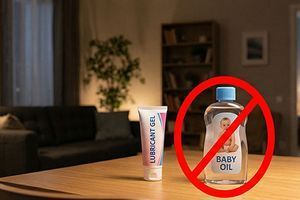
- using lubricants for comfort
- intimate toys as tools of sensitivity
- intimate cosmetics to enhance bodily response
Modern intimate products are not “entertainment,” but tools that help the body engage, reduce tension, strengthen contact, and restore sensitivity. That is why in many couples, with their appearance, the need to pretend sharply decreases.
When simulation is a chance
Fact: if the topic of pretending opens up in a couple, it is not the end of closeness, but an opportunity to take it to a new level.
Because behind simulation there is almost always a desire to preserve the connection. Which means it can already be worked with.
Honest conversation, lowering pressure, attention to the body, care for comfort, and openness to new things very often return not only orgasms — but also the feeling of “we.”
Conclusion
If a partner is pretending, it is not a sentence and not a reason to fight. It is a signal. About tension and fears, and that the intimate sphere requires more attention, safety, and dialogue.
This is exactly what Sexopedia Safe Your Love is about — a space where pleasure begins with understanding.