How to measure condom size: a chart by penis girth
According to the SizeMe study almost 45-50% of men use condoms that aren't their size. Standard models fit only about 70% of the population, while the rest struggle with slipping or too-tight fit. We break down how to measure penis girth at home in 30 seconds, what "nominal width" means on the packaging, and give you a condom size chart matched to your anatomy.
Why the right condom size matters
The wrong condom size isn't just about comfort. If it's too big, the contraceptive slips during movement and the risk of STI transmission or unwanted pregnancy multiplies. If it's too small, the latex overstretches and can tear, plus sensitivity drops and blood circulation in the glans worsens, which sometimes leads to a partial loss of erection in the process.
There's another aspect that gets underestimated, the psychological one. Many men are uncomfortable browsing sizes at the pharmacy, so they grab "standard". And standard is a template, it doesn't fit your specific anatomy by default.
How to measure penis girth correctly
You only need a flexible measuring tape (like for sewing) or a regular string plus a ruler. No special instruments needed.
Step by step how to measure your penis correctly:
- Get a full erection first, without it the measurement is inaccurate.
- Measure the girth at the thickest part of the shaft (usually the middle between the base and the glans).
- The tape should fit snugly but not dig into the skin.
- Write down the result in centimeters, for example 12.4 cm.
If you don't have a measuring tape, wrap a string around your penis, mark where it crosses, then hold it against a ruler. That's why it's worth keeping a sewing tape in a drawer anyway, it'll come in handy for other things too.
The second measurement sometimes asked for is length from the base to the tip of the glans. For condoms it's not critical, because latex stretches in length easily. But for most masturbators and cock rings it already matters.
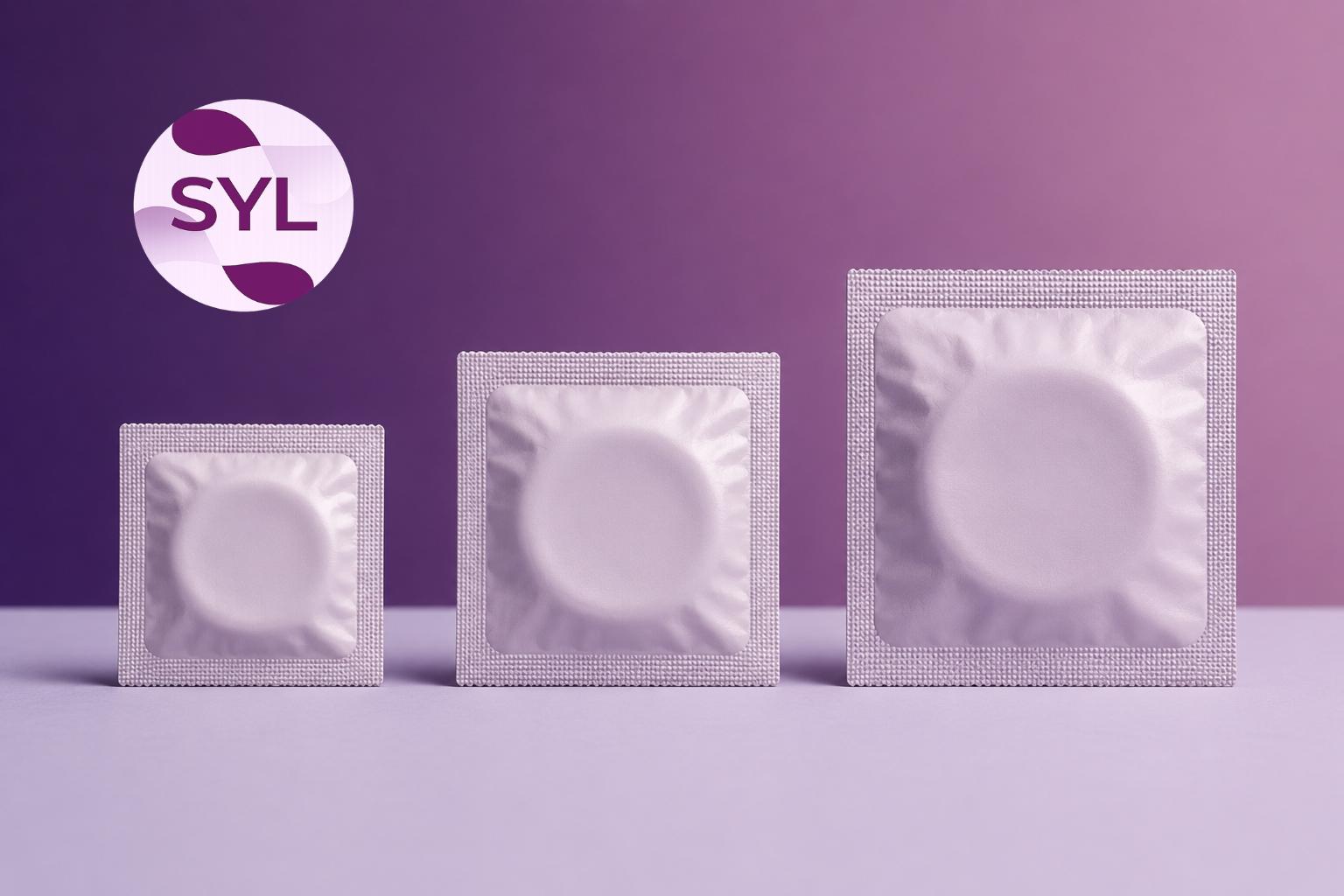
What "nominal width" on the packaging means
On the back of every condom the manufacturer prints nominal width in millimeters. This is not the diameter or the girth. It's half the circumference of the latex in its flattened state.
For example nominal width 54 mm means the full condom circumference unstretched is approximately 108 mm or 10.8 cm. The latex itself stretches another 20-30%, so the actual working range is a bit larger. But for basic sizing use this number as your reference, your penis girth should be close to 2× nominal width or slightly less.
Condom size chart by penis girth
Here's how penis girth corresponds to condom nominal width and which category to look for on the packaging.
| Penis girth | Nominal width | Category | How to find it on the packaging |
|---|---|---|---|
| 9-10.5 cm | 47-49 mm | Snug / Slim Fit | "small", "slim", "close fit" |
| 10.5-11.5 cm | 49-52 mm | Snug | "snug", "fitted" |
| 11.5-12.5 cm | 52-54 mm | Standard | standard with no extra labels |
| 12.5-13.5 cm | 54-56 mm | Comfort | "comfort", "extra" |
| 13.5-14.5 cm | 56-58 mm | Large / XL | "large", "XL" |
| 14.5+ cm | 60+ mm | XXL / King Size | "XXL", "King Size" |
If your girth falls between two sizes, go with the larger one. A tight condom is more dangerous than a slightly loose one because it tears more often.
Size ranges of top brands
Not all manufacturers make a full size range. Here are the brands that give you a real choice by size.
Durex. The widest lineup of those available in Ukraine. Basic 52-54 mm, Pleasuremax 56 mm, XL Comfort 60 mm, Sensation Slim 49 mm. Most convenient if you're still experimenting and trying to find "your" size.
Pasante (UK). Has probably the widest spectrum from Trim 49 mm for a slim fit condom to King Size 60 mm. Best choice when your girth is non-standard in either direction.
Maxus. Ukrainian brand, base line 52-54 mm, there's Maxus Air with thinner latex and Maxus XXL 60 mm at a lower price than the comparable Durex.
Skins. British, interesting for their wide XL lineup (Skins Featherlite XL) at a moderate price. Thin latex combined with an enlarged size isn't something you find together often.
Contex, VIZIT. Budget options with a standard size 52-54 mm. Non-standard size ranges are limited, but for an average girth they work just fine.
Common mistakes when choosing a size
Measuring a flaccid penis. Size changes 1.5-2 times with an erection, so that measurement is simply pointless. Wait for a full erection.
Going by length instead of girth. Most condoms of standard length (180-200 mm) stretch to fit any real-world length. The issue is specifically with width.
Buying "tighter for safety". A tight condom tears more often than a loose one, because the latex is overstretched and has no room to expand during movement.
Buying standard because a friend said so. Your friend may have completely different anatomy. Measure yourself, numbers don't lie.
Forgetting lube. Even a perfectly sized XL condom without extra lubricant causes friction and shortens the wear time. Especially for thinner latex like Skins Featherlite XL.

Conclusion
Knowing your condom size is basic intimate hygiene, like knowing your blood pressure. You measure once, write it down, then buy the model with the right nominal width without thinking about it. If your girth is between sizes, go bigger. Above 14.5 cm look for XL or King Size labeling, below 11 cm look for Slim Fit or Snug.
You can browse the full condom range with size filters in the SafeYourLove condom catalog, and add a water-based lubricant to your order from the lubricants section, without it even a perfect condom feels different.